There’s some sort of public love triangle brewing between Drake, Karol G and Bruno Mars. It appears to be playful and not anything serious, as the trio are fans of one another, but fans are wondering: Could this all be leading up to a seismic blockbuster collaboration?
Earlier this week, Bruno cast Karol G to play his love interest in the romantic “Dance With Me” music video, which saw the 6 God pop up with a response on Instagram.
Related
Bruno Mars Asks Karol G to ‘Dance With Me’ in New Music Video
Karol G Brings Out Bruno Mars for Surprise Live Debut of ‘Still’ at L.A. Concert
Drake Surprises Karol G’s Houston Crowd With ‘Ahí,’ ‘Janice STFU’ & ‘One Dance’ Performances
“Holy this guy works fast,” he quipped Thursday. The comment has amassed more than 34,000 likes, while Bruno’s post itself has north of a million.
This all heated up pretty quickly this week. Drake made a guest appearance at Karol G’s Houston show on Sunday, which saw him passionately dancing with the Colombian superstar as he performed his 2016 Billboard Hot 100 No. 1 hit “One Dance.”
They also teamed up for the live debut of their “Ahí” collaboration, which reached No. 44 on the Billboard Hot 100 and topped the Hot Latin Songs chart in August.
Bruno was left a little jealous after seeing what transpired at Reliant Stadium. The Grammy-winning artist posted a photo from his private jet looking out into the clouds, vowing to make a play to one-up Drizzy and win Karol G back.
That happened to be the steamy “Dance With Me” video, which Bruno knew he had up his sleeve and ready to launch on Thursday. He gushed about Karol G in his heartfelt caption, championing her work ethic and called her the “Juliet” to his Romeo.
“Watching you work has been so inspiring. For those that don’t know this beautiful woman works so hard and loves her fans so much. She calls me and tells me how blessed we both are and reminds me to never forget that,” Bruno wrote on IG. “I’m honored to say we made music together, performed together and now starred in a high drama telenovela together. The world needs your light and your voice Carolina. Thank you for being my Juliet in this music video.”
There could be something in the works, or perhaps this was all a marketing ploy leading up to the “Dance With Me” visual and Drake just played along. A collaboration would be a first from the trio, and boast some of the most potent star power a song has seen, while taking artists from different genres.
Like Drake, Bruno Mars also appeared on Karol G’s No Me Arrepiento de Sentir Tanto album in August, as the duo tangled on “Still,” which peaked at No. 41 on the Hot 100. Bruno hit the stage at Karol G’s Aug. 15 show in L.A. at SoFi Stadium, where they performed the live debut of “Still” as well as his The Romatic opener “Risk It All.”
The Mexican ska rock band Panteón Rococó joined the list of Latin acts performing on NPR’s iconic Tiny Desk on Thursday to celebrate Hispanic Heritage Month. The band used the emblematic platform to highlight the causes they support, such as the pro-immigrant movement and the crisis of disappeared persons in Mexico.
The legendary act, led by vocalist and social activist Dr. Shenka, performed some of their most well-known songs, including “1993,” dedicated to the nearly 133,000 people reported missing in Mexico, according to official figures cited by The Associated Press.
Related
Las 50 mejores bandas de rock en español de todos los tiempos, clasificadas
Panteón Rococó reúne a más de 120.000 personas en multitudinario concierto gratuito en México
Mira a Milo J traer el folclore sudamericano y la murga uruguaya al Tiny Desk de NPR
“We’re representing Mexico City, the great monster,” Dr. Shenka said in his introduction. “So this next song, ‘1993,’ is dedicated to all the disappeared in Mexico,” he added, in a mix of English and Spanish.
During the session, guitarist Leonel Rosales can be seen wearing a T-shirt with the phrase “no human being is illegal” in Spanish — a clear stance against U.S. immigration policies — while bassist Dario Espinosa sports a shirt featuring an image of a dog urinating on an ice cube, in what could be a reference to ICE (U.S. Immigration and Customs Enforcement). Guitarist Rodrigo “Gorri” Bonilla wears a shirt with the logo of the German soccer team St. Pauli and the phrase “Make Fascists Afraid Again.” And Dr. Shenka is seen wearing a sports jersey in the colors of the Palestinian flag.
Their energetic set includes classics like “Arréglame el alma,” “Cha-Cha Love,” “La dosis perfecta” and “La carencia.” Just over 24 hours after its release, Panteón Rococó’s Tiny Desk session had already surpassed 1 million views on YouTube.
Their participation in NPR’s series comes ahead of their Dec. 26 show at the GNP Seguros Stadium, before taking an indefinite hiatus, as announced by the group. Vocalist Dr. Shenka suffered a mild heart attack in June 2025, which required the band to take several weeks off for his full recovery.
This year, Panteón Rococó was also recognized by Billboard as one of the 50 Best Latin Rock Bands of All Time and held a historic free concert for more than 120,000 people in Ciudad Neza, one of the most densely populated municipalities in the world, to celebrate their 30-year career.
After spending over a decade pushing pop forward from its periphery, Charli xcx seized the zeitgeist in 2024 with Brat. The Grammy-winning album propelled her to arena headliner for the first time — and now the 34-year-old is filling those same rooms and topping festival bills in support of her July rock-infused album, Music, Fashion, Film.
For the tour, which wraps its North America leg in October and heads to Europe in February, she’s still doing things her way, with an uncompromising, high-concept show that leans heavily on Brat and Music. “I’m not really performing to please anyone other than myself,” she says, “which is maybe not the attitude that everybody takes, but that’s the attitude that I take.”
Related
‘Every Moment Is Massive and Magnificent’: Noah Kahan Reflects on a Monumental Year — And Eyes a Grammys Breakthrough
Kid Rock Searching For Salvation on Upcoming ‘Halfway to Jesus’ Christian Rock Album Featuring Eminem Collab
Mel C Is Donating Some of Her Best Kit For a Good Cause
You debuted this show while headlining Chicago’s Lollapalooza for the first time. How intimidating was that?
That was so wild, to be honest, and really exciting. I think there’s that sort of inner battle to fight this voice of what people might want from you versus the kind of artistic vision of what’s true to the album, and luckily that voice never got too loud. There was a world where I could have played songs from my catalog that everybody definitely knows — but I am not really that interested in doing that anymore. Especially a festival headline set, I like to use that as an opportunity to really put forward my most pure vision as an artist. Maybe that is something that not everybody will like. Maybe that’s something that new people will discover. But I [wanted] to use it as an opportunity to challenge an audience and the idea of what a festival set can be.
How does touring allow you to express a side of your creativity that you can’t in the studio?
For this show in particular, we really wanted to make things feel as cinematic as we possibly could, whilst obviously understanding the parameters of being in an arena. Being in an arena, you can make things feel really maximalist. You can throw all of the toys [at an audience] right away. But I think what we’ve done with the show is we’ve practiced some restraint, so that when you do feel that moment of pyro, it stands out.
Was there something with this show that you had always wanted to do but hadn’t previously been able to pull off?
Yeah, like, the whole thing. [Laughs.] As an artist, I’ve really climbed my way up from nothing — I used to perform with an iPod on a makeshift stage, and that was my production. The thing that’s interesting is every time you get closer to doing your dream show, you realize that, actually, it’s worth putting the money back in rather than like taking the money and running, because I want to do a show that feels artistically challenging. I feel challenged. I hope people who watch it feel challenged at points too.
Putting on a show of this scale takes a village. How did your creative team support you?
I’ve worked closely with [creative director] Imogene Strauss, who is essentially one of my best friends, on building numerous tours of mine. She knows what I mean, I know what she means. We have a linguistic shorthand where we can just get to the core of an idea really fast. I have a similar language with [producer] A. G. Cook in the studio. Working on the musical direction of the show is really important too, and that’s something that I start months and months in advance with Mitchell Snyder, who is someone who I’ve worked on my shows with for a long time. It’s almost like making a remix album, using all of the stems, deciding where we’re putting “oblivion is freedom,” deciding that we’re even doing that, starting from nothing. The choreo on this show was really, really important, too. I worked with Eric Christensen, who has done a lot of runway-related work in the past, he works a lot with Mugler, I’ve worked with him before with Saint Laurent when he was doing movement direction on a photo shoot. I really wanted to work with someone who had an extensive fashion background and was doing shows and was understanding the variety of different walks.
The Music, Fashion, Film artwork features the luminaries John Cale, Marc Jacobs and Martin Scorsese. Were there any tours or musicians who inspired this tour’s creative direction?
It wasn’t really tours. It was more, like, different tableaux, different paintings. Like, Caravaggio paintings have always been quite important to me. There’s like a real rawness to them. The way that he’s using kind of untraditional models to paint real people. Then just like the energy of the performance, I was thinking a lot about people like [actress] Béatrice Dalle, and how she’s so strong. I don’t actually go to that many live shows to be honest.
A David Cronenberg monologue ends Music, Fashion, Film, and one line — “oblivion is freedom” — recurs throughout the show. Why that specific line?
It’s the part that’s most related to how I feel about performance, for better and worse. For me, performing live is very physical, sometimes very painful. I just have to throw myself into it and lose my inhibitions and almost enter another state — which might sound pretentious to some people, but whatever. I have to lose myself to be able to feel free onstage, and so “oblivion is freedom” was the perfect thing to pepper across the live show, because it’s genuinely how I feel when I perform and it’s the mission statement of the album, in a way. Destroying what is comfortable and what you know can sometimes lead to this new creative freedom.
How do you view the totality of the show?
It’s my perspective on being an artist, yes, but also being human. Not to get too deep — I know that, for some people, it’s just a pop show, and I’m happy for people to enjoy it like that — but I think there is a chaos and a freedom and a sadness and a beauty to existence, and I suppose I’m trying to put all that into this one show. I think I have been a walking contradiction throughout my life as an artist, but I think that that is what it is to be human. It can be about whatever it can be to other people. But for me, it’s kind of about that.
A version of this story originally appeared in the Oct. 3, 2026, issue of Billboard.
Less than a week after releasing Returning to Myself (Sad Gay Version) — a deluxe edition of her 2025 album Returning to Myself featuring pared-down, intimate recordings of its 10 songs plus a new track — Brandi Carlile brought her Bramily (Brandi Carlile fans) and the sad, gay vibes to the Stonewall Inn in Manhattan.
Considering Stonewall’s history as ground zero for the modern LGBTQ rights movement — a place where generational queer pain and joy exist in equal measure — the Stonewall National Monument Visitor Center was a perfect setting for Carlile to celebrate this Sad Gay Version of her Billboard 200 top 10 album.
Sitting down with renowned photographer Collier Schorr (who shot the Returning to Myself album cover) for an insightful chat, Carlile talked about how LGBTQ musicians always bring a “little sparkle” to their sad songs and emphasized the “importance of spaces like [Stonewall]” in today’s political climate. Agreeing with her, Schorr offered a succinct, very queer-coded metaphor for America in 2026: “It’s like, where’s the Emerald City? It’s black and white again.”
After the discussion ended (with Carlile promising to take Schorr halibut fishing), Carlile brought out her band to deliver an hour-long set of the Sad Gay Versions of Returning to Myself, including the contemplative “A Woman Oversees” and the heart-wrenching “A War With Time,” songs about her wife and children, respectively. She also performed her contribution to the Practical Magic 2 soundtrack, a cover of Billy Joel’s “And So It Goes,” and explained how that came about.
“I got a FaceTime from Sandra Bullock,” Carlile shared. When someone in the audience yelled out “hot,” Carlile laughed and replied, “Preach.”
“She knows what she’s doing in a flannel shirt,” Carlile said of Bullock. “She knows exactly what she’s doing when she shows up to a Brandi Carlile concert in a flannel shirt. And I do appreciate it. She asked me to do this song for Practical Magic 2.” Of the latest Bullock and Nicole Kidman film, Carlile added, “I love it so much. I think it’s such an eccentric, weird take on matriarchy and I loved it.”
Oddly, a practical glitch led to one of the evening’s most magical moments. After the sound cut out during “Human” (the new track on her deluxe edition), Carlile and her band offered up a truly acoustic, speaker-free performance of “The Joke” as the tech team worked to get the sound back. That Grammy-winning song is obviously one that Carlile has performed a lot, but hearing her sing it to a small room with no technical amplification made it feel fresh, urgent and honest.
After the show, Carlile joined her Bramily at the Stonewall Inn next door for tequila shots, then headed up to the second floor for “Sad Gay Karaoke.” With help from the New York City Gay Men’s Chorus, she belted out Celine Dion’s “It’s All Coming Back to Me Now” before leading the entire bar through a sing-along to Madonna’s “Like a Prayer.” A tough act to follow, but more than a few brave souls did, with Carlile even popping back onstage to join in on a karaoke version of the Chicks’ “Goodbye Earl.”
HorsegiirL is opening for Robyn tonight (Oct. 2) at the Kia Forum in Los Angeles, but if she’s nervous or even antsy to get to the venue, she doesn’t let on.
Instead, the German producer projects a sort of grounded calm when we meet at noon on a sunny patio in downtown Los Angeles. Here, the sound of a jackhammer pulverizing some nearby concrete functions as a sort of equal and opposite reaction to both her vibe and the body of work she’s most recently released, her June debut Nature Is Healing.
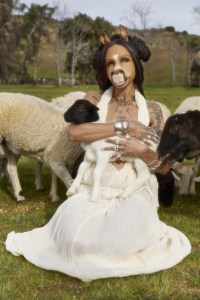
Celestial and sincere but also often unhinged (listen for the cameo from The Doctor in the album’s “An Apple a Day”), the album helped cement horsegiirL’s status as a key of-the-moment dance star with strong pop girl (or pop horse) tendencies. These exist in both the structures of her music and the fantastical world building achieved through presenting herself as a stylish equine named Stella Stallion that exists in a natural wonderland world that’s like if Lisa Frank met Planet Earth. This persona isn’t a gimmick, but a fully realized artistic universe, with its own internal logic and a hyperpop-meets-pop-meets-hardcore-dance soundtrack that horsegiirL has been carving out since her come-up through the Berlin rave scene, which she broke out of with her 2023 single “My Barn, My Rules.”
Planet horsegiirL has its own gravitational pull. In preparation for this story, I’m sent a folder of images of Stella Stallion with a bevy of other pop girls/peers: Sabrina Carpenter, Grimes, Cobrah, Zara Larsson, Kim Petras, North West. (There are also shots of her with actors Adam Scott and Lisa Rinna.) In April, she made cameos during the Coachella performances of English rock darlings Wet Leg and British dance pop star PinkPantheress, moments that followed her own 2025 Coachella debut.
“A major shift was when I played Coachella last year,” Stallion says when contemplating her breakthrough. “I’d played Portola the year prior and that was already a big moment, and I think those two festivals plus what came after was a slow and steady growth.” She says her U.S. audience is now the biggest of anywhere in the world.
Many of these fans will see horsegiirL on her North American headlining tour, which started Sept. 19 in Denver and gallops along through mid-November before heading to Europe. (Her routine for staying a healthy horse on the road: exercise, abstaining from alcohol and up to 10 hours of sleep a night. “I don’t care if people judge me for it, because I need the sleep,” she says.)
The tour comes towards the end of a year that started, as horsegiirL recalls, with the first time she ever really felt like she belonged in the U.S. music scene. “It was during Grammy weekend,” she says. “There was this Spotify event I went to where it was like, ‘Wow! I don’t feel like an imposter all of a sudden. I have this invite because I’m allowed to be here.’” (Still, when asked if she aspires for Nature Is Healing to get a Grammy nod, she says she’s “not very much of an awards kind of girl,” given that “I don’t really think a Grammy says a lot about the quality of someone’s work.”)
On Oct. 30, horsegiirL will release Hardcore Healing, a new EP that, as its title suggests, integrates the rave, happy hardcore and gabber sounds that have long been part of her live repertoire and part of her world since she was a kid growing up in the German countryside, surrounded by nature with a geologist mom. The project features collaborations with Parisian gabber star aamourocean, frequent PinkPantheress collaborator Count Baldor and horsegiirL’s own frequent collaborators Free Jimi and Luvhunter. Released this week, the project’s lead single “c*ntry girl rock” is a collaboration with cool guy producer Dylan Brady that fuses hardcore and country into a song that’s wildly catchy, kind of strange and quintessentially horsegiirL.
Here, Stallion talks about healing, the pop path and what it means to be a horse.
You just started your first North American headlining tour. What’s the show like?
The show is very theatrical. I’m dancing, I’m singing, and I have moments behind the decks, so it’s really a new chapter and a great mixture. I feel both like old horsegiirL and this new pop girl path I’m on. With Nature is Healing, because it has so many downtempo and vocal heavy tracks, to do the album justice and tour it right, I needed to change the show as well, because it’s not really just a DJ album. It’s also really exciting to not be alone on stage, to have dancers with me, because DJing can be isolating sometimes, especially on big festival stages.
Is that pop girl path something you’ve intentionally been trying to cultivate, or has it just kind of happened?
I was always a bit of a pop girl, because all of my tracks, even from the very early ones like “Harvest Heartbreak,” always had a very classic pop structure in the sense that it’s verse, pre-chorus, chorus. It’s quite hooky. It maybe has pop culture themes, like star signs and whatever. I always leaned into that, but always combined it with quite a fast BPM, which immediately makes it maybe less radio friendly. But it wasn’t a conscious thing for Nature Is Healing. It was just that I had a lot to say, and I couldn’t have fit it into a strictly electronic club record.
Are there elements of the pop path that you’re especially enjoying?
What I really like about pop artists and pop girls specifically is that they can have different eras. I was always fascinated that a lot of pop musicians will reinvent themselves and explore sounds and don’t need to stick to one genre, per se. That is one of the big things I love about pop music. I listen to so many different kinds of music that I always found it very hard to stick to one genre when it comes to my own music. It felt quite restrictive, and I think in pop, people want artists to showcase different interests and inspirations. I really like that about pop. And then the over the top-ness, the theatrics of pop, I find that super cool and interesting and fun.
I wonder if that over the top-ness and theatricality lends itself especially well to how you present yourself to the world, given that you are a horse.
Horses are very over the top. I think that’s why I probably would not want to be like, a minimal techno DJ.
Is there a sort of philosophy behind the way you present yourself?
I think the reason why I’ve been embraced so much, especially in a queer context, is because a lot of people have experienced the confinement of societal boxes. I think everyone yearns for the freedom to just express who you truly are, instead of being prejudged.
Also when you asked me about pop stardom, something I always found really scary is fame to that level, where you cannot leave the house and you cannot ever go back to a normal life where you can actually live and experience things like a normal person. I can only imagine how that feels, and I don’t know if I would ever want to trade my privacy for that.
Does being a horse give you a kind of freedom that a human artist might not have?
Because I’m a horse, I feel like people can also project what they want onto me, whereas a lot of human artists come with a past, they come with class, race, gender, all of these things that in a way immediately determine, or determine to a bigger degree, how they’re placed within the music space and who will even give them a chance and listen to them.
On the music side as well, because I grew up in Germany, I do think a huge part of me is always rebelling against being put into this box for brown horses. Whenever I would tell someone I make music, it’d be like “Oh, do you rap?” or “Do you do R&B?” Hardcore and gabber were very much open spaces, but they’re predominantly white, but it’s also what I grew up with, so I’m reclaiming that a bit.
Horsegiirl
Alex Lockett
Right, so the title of Hardcore Healing is obviously clever given that the project features sounds like gabber and happy hardcore. What ideas are you exploring with the project?
There’s an idea of healing sometimes, especially in Western contexts — and also the understanding of Eastern practices like meditation and yoga that are always supposed to look very calm, as if healing and having a healing practice only needs to look one way — where you arrive at this calm state of just like, constant floating. I don’t feel like that’s the whole process of healing. I feel like healing can also be raging and moving quick, instead of just calmness. I think that’s just as important. I find it very healing to go into a club space and move with a lot of bodies around me and not just this like, super self-focused, self-work, self-individualist idea of healing.
Tell me about making it.
We went to the countryside and locked ourselves in this house for a week and a half and just made a bunch of music. It’s nice to work with people you know. Like, I really enjoy the process a lot more when there’s a friendship established and it’s not this business-esque way of going into a bunch of writing sessions.
Take me through a typical day in the countryside.
Wake up at 10, have breakfast, then start making music ’til we get really hungry around four. Go forage for food, which wasn’t always easy because the next supermarket was like, a 40-minute drive away, then work ’til midnight, then make a fire and roast things on the fire, and then go to bed at three.
How does Hardcore Healing relate to Nature Is Healing?
Nature Is Healing caters to a bit more downtempo, less club sound, and I felt like I wanted to still do something this year that’s more back to my club roots. A little less vocal heavy, faster BPM, still euphoric, still kind of in line sonically, but reinterpreting some of the sounds that I used on Nature Is Healing in a more club setting.
In your recent NME cover story you talked about hardcore and gabber being genres popular among working-class people in Germany, and I wonder if that’s how you were thinking of country music too, in terms of how you fused the two genres on “c*ntry girl rock.”
One hundred percent. I feel like there’s a lot of city girl music and not enough country girl music, and I really think the fusion of hardcore and country has to happen. I’m just getting the ball rolling, starting to get that genre fusion out there with country girls.
I don’t know if I’ve ever heard anything like this song.
In Germany, a lot of country people listen to hardstyle and jumpstyle and stuff, and there’s a German version of country called Schlager. So there’s already this duality, especially if you’re going to a country Octoberfest kind of thing — not the actual Munich one but just a small town one — that there will be country played during the day, and then it kind of goes into harder stuff at night. I can see that working for the U.S. too.
Given all these factors — pop, hardcore, country, healing, nature, club music, etc. — how do you describe the world in which you exist right now? Like, what is the world you’re bringing to life on stage?
I think it’s still quite chaotic, in a weird way. It’s like, nature, chaos, rave. The challenge going into this tour was how I could still provide a really high-energy show without losing fans that come to really dance and shake a–, but also, how can I have these serene moments of singing and really emotional moments? So yeah, nature chaos rave.
Sienna Spiro always beats Omer Fedi to the studio. “I’m usually pretty early — I’ve never gotten there before her,” the hitmaking producer tells Billboard with a laugh. “She’s always there on the piano, like, ‘OK, I have a song.’ The best stuff that we’ve made together is stuff that she basically comes to the studio with the song 99% done.”
So, when Fedi arrived at New York’s Electric Lady Studios for one of the rising English singer–songwriter’s last sessions for her debut album, Visitor, she greeted him — with the idea, hook and chords for single “Great Expectation” ready to go. “She said, ‘Oh, I had this idea. What do you think?’ ” he recalls, still in awe. “[She] did it all alone, sounding amazing.”
This is a side of Spiro with which the public — knowing her more as an incredible vocalist than anything else — isn’t as familiar. But at just 20 years old, she’s completely in control of her artistry, down to every word she sings.
The London native was just a teenager when a TikTok of her singing Finneas’ “Break My Heart Again” yielded an immediate influx of interested managers and, soon afterward, label offers. Since partnering with Miriam Maslin at Method Music for management and inking a deal with Capitol Records, she’s established herself as one of Gen Z’s most gifted performers — and has proved her hitmaking capabilities.
By early 2026, Spiro had made her first appearance on the Billboard Hot 100 with her breakout single, “Die on This Hill,” which went on to peak at No. 19. (Meanwhile, since its July debut, “Great Expectation” has been climbing the Hot 100, and it recently made Spiro the youngest British female artist to score a U.K. No. 1 in 12 years.) And yes, she really does write all of her own songs.