All products and services featured are independently chosen by editors. However, Billboard may receive a commission on orders placed through its retail links, and the retailer may receive certain auditable data for accounting purposes.
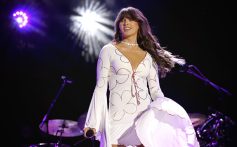
“Gaming is something I do whenever I have time to relax, so getting to create this collection with PlayStation was very exciting,” LISA said of the collab. “I had a lot of fun adding in little details that I knew my fans would notice, and I wanted the fans to have something they can connect with.”
The LISA limited-edition controller arrives Oct. 30 in limited quantities, while the accompanying merch collection launches Oct. 23 with apparel, hats, tote bags, keychains, stickers and more. Both the controller and select merchandise will be available for preorder beginning Oct. 2 at 10:00 a.m. local time through PlayStation and LISA’s official Amazon store.
LIMITED EDITION
PlayStation DualSense Wireless Controller – LISA Limited Edition
For fans in the U.K., France, Germany, Austria, Spain, Portugal, Italy, the Netherlands, Belgium and Luxembourg, preorders for the LISA Limited Edition DualSense wireless controller will also open Oct. 2 at 10:00 a.m. local time through PlayStation’s online store. Quantities are limited, so fans will want to press play as soon as preorders go live.
LISA is set to release her new EP, “PRESS PLAY,” on Oct. 23, following her 2025 solo debut album, “Alter Ego,” which was No. 1 on Billboard’s Top Album Sales chart. She previously launched her solo career with the 2021 single album “LALISA,” featuring “LALISA” and “MONEY.” Still a member of BLACKPINK, LISA reunited with the group for its 2026 mini album, “DEADLINE,” and its DEADLINE world tour.
The first time producers Aaron Dessner and Gabe Simon met was around the 2024 Grammys; the next was last spring, in Dessner’s upstate New York backyard. As Dessner puts it, that second meeting, at his Long Pond studio, was the pair’s “first immersion” into working together on what would become Noah Kahan‘s epic 2026 album The Great Divide. There, with Kahan, they wrote three The Great Divide songs.
While the two had different degrees of history with Kahan — Simon collaborated on Stick Season; Dessner had a golf, soccer and getting-to-know-you writing session with him at Long Pond — the two united to help Kahan bring cohesion across the album’s 21 songs (including its deluxe edition). They spoke about why it was “brilliant” of Kahan to pair them up.
Related
‘Every Moment Is Massive and Magnificent’: Noah Kahan Reflects on a Monumental Year — And Eyes a Grammys Breakthrough
6 Artists Who Lost the Best New Artist Grammy Could Be Nominated for Album of the Year at 2027 Awards
Noah Kahan: Photos From the Billboard Cover Shoot
Aaron, what made you want to work closely with Noah?
Aaron Dessner: I was a fan, like everybody, of Stick Season and I had seen him play [at] Boston Calling [in 2023]. [My band] The National was playing after Noah and it was in Boston, an epicenter of his fanbase. And I remember all the dudes in The National were watching and everyone was singing every word and it was just amazing — and also classic The National, we had to go on after that and we were like, “Womp womp.”
Gabe Simon: The curse of every great indie band.
Dessner: And then when I got to record Gracie [Abrams] and play some guitar and stuff on [the Stick Season (Forever) remake of] “Everywhere Everything,” of course you get inside something and you feel things … Any songwriter, if you’re a fan and make music every day like we do, you always dream of how you would bounce off of it.
Simon: I remember, this was probably August right before Noah went up to work with Aaron, and Noah came to me like, “Dude, I’m going to work with Aaron Dessner.” He was so excited. We had done “The Great Divide” early on in the process and then he was in this weird figuring-out-what-the-f–k-is-going-on phase. He had been doing some writing with outside writers and it wasn’t going well and it was the first time I saw a glimpse of him being excited about bringing in another collaborator. It was a perfect stimulus that we needed to start rounding the corner.
Dessner: And from the other side, it was always clear that Gabe and Noah had been doing heavy excavation, basically, with “The Great Divide” and “Doors” and these huge songs that took a lot of effort to figure out what they were, and also pushing into places that were different, and Noah had nerves about that. Because you guys had made a really classic album that this was coming after, and that’s not the easiest thing for anyone.
Simon: It’s a total b-tch. Eventually, when we got together in the fall of last year, we were starting to inch toward this cohesion.
Dessner: I think that was a brilliant decision of Noah’s to basically combine us at different points, especially at the end because we had to bring it together somehow. At the end of the process, we took everything down to Nashville where Gabe often works at Gold Pacific [Studios].
Simon: Aaron and I got to have a couple of days just him and I, really looking under the hood and getting on completely the same page, which I think is something that is really lost in the collaboration process when you’re making records with more than one producer.
From left: Simon, Kahan and Dessner.
Gracie Reichel
You two and Noah were the sole writers and producers on the angsty “Downfall” and “A Few of Your Own” and the intimate “Lighthouse.” Gabe, you’ve said Noah wanted to write “angry dark s–t,” but these came out instead … Do earlier angrier versions exist?
Simon: It’s funny: “Orbiter” was a song that he started writing when we were doing the Forever deluxe. We had a demo of “All Them Horses” and then he started playing this emo-grunge version of “Orbiter.” The only thing he had was, “I circle you-u-u-u-u-u,” and we were all like, “Yeah, pretty cool, man.”
Dessner: Nine times out of 10, a song like that would not be what it is. But there’s a weird magic of his fanbase and him as a songwriter that people are listening to. I don’t think anyone, including Noah and definitely the label, could have seen that.
Simon: The sad angry dark s–t, you have not heard. But at the same time, you have “Downfall,” arguably one of the most f–ked-up songs, period. But it’s done in a way that has a levity and almost feels more Fleetwood Mac, so it doesn’t leave you feeling like Noah is a d–k for saying what he’s saying; it has a joy to it.
Noah does balance heavy lyrical concepts with melodic production — and his live shows really highlight that.
Simon: You have these people who are dancing to songs like “New Perspective” and “The Great Divide” with lyrical concepts that are really hard and heavy, but they’re doing it with such joy. I grew up in a churchy community and I’m not really in that space anymore, but what I loved was that sense of people being connected and able to sing something together and have a spiritual experience. And there’s something about the way that Noah opens up and is vulnerable about himself — he’s self-deprecating, hilarious but also there’s not a night that he’s not going to cry on “Willing and Able” or [have] a pin-drop moment for a track like “Orbiter.”
Why do you think The Great Divide has become bigger than Stick Season?
Simon:Stick Season took three years to become really big and I think that now, it’s like, “Oh, it’s always been big.” But it wasn’t. And people are still really liking Stick Season, and then you double down on it with a record that gives them about 20% more of what they want, but about 80% new narratives, new directions, new intentions, new storylines. It’s not about a place anymore, it’s about the people he connects with. You can get lost in the lore of that. And I think what was so cool about it was watching these people go crazy on the internet talking about the way the songs connected them in different ways and different therapists breaking down their meanings. It’s no longer about music — now it’s about culture and people, it’s about humanity and society as a whole. I think that’s why it’s bigger.
I’m assuming there’s still music on the cutting room floor. What would your hope be if there is?
Dessner: It’s a curious question because I don’t know that [Noah] writes bad songs. But I also think a lot of these songs are specific and there tends to be a conversation happening.
Simon: We had a whiteboard [that] had all the narrative ties. Some people have whiteboards for “put tambourine here.” Our whiteboard was like, “Is this talking about your brother, your sister, your friendships, your marriage? Is this talking about yourself?” If a song didn’t fit fully — even if it was a banger — it did not make that cut. And I think that shows how willing Noah was to just focus on the narrative, because he’s definitely not going, “This is my last record.”
This story appears in the Oct. 3, 2026, issue of Billboard.
Ella Langley’s “Choosin’ Texas” is the newly minted record holder for the most weeks at No. 1 in the history of the Billboard Hot 100, with its reign now up to 24 weeks.
“Just thank you so much. It’s changing my life, it’s changing the lives of the writers of this song,” Langley marveled Sept. 22 on Instagram about “Choosin’ Texas,” which she co-penned with Luke Dick, Miranda Lambert and Joybeth Taylor. “It’s changing the lives of my family and it is truly growing an atmosphere for something I’m gonna be able to do the rest of my life.”
Related
How Has Ella Langley’s ‘Choosin’ Texas’ Spent 24 Weeks Atop the Hot 100 — And Why Are People So Shocked By It?
What are the leaders on Billboard’s other multimetric song surveys?
In addition to the Hot 100, Billboard publishes weekly “Hot”-named charts that measure songs’ U.S. streams, radio airplay and sales in genres covering Christian, country, dance, gospel, Latin, R&B/hip-hop and rock/alternative. Plus, the Holiday 100 does the same for festive songs during the holiday season each year.
Among those rankings, the Hot 100’s history dates to Aug. 4, 1958. Hot Country Songs and Hot R&B/Hip-Hop Songs became the respective genres’ singular listings in October 1958, following beginnings in various forms in the 1940s. Hot Latin Songs (October 1986) and Hot Rap Songs (March 1989) also trace back before this century (with all charts below having shared the Hot 100’s current methodology since October 2012).
Below, Billboard runs down the longest-leading hit on every “Hot”-branded songs chart (through rankings dated Oct. 3). In the cases of the top titles on Christian, country, dance/electronic, R&B/hip-hop and rock/alternative lists, songs’ crossover success at multiple radio formats helped them reach historic runs at No. 1.
“I feel like I’m on a wave and I actually know how to stand on the board at this point,” Kylie Minogue toldThe Guardianshortly before dropping her eighth studio effort Fever. “I feel quite solid. I don’t know where it’s taking me, but everything feels really good.”
It’s little wonder that Australia’s greatest musical export was so confident. She’d just staged one of pop’s greatest ever comebacks with 2000’s Light Years, a return-to-form in which she also returned to her effervescent pop roots. And as foreshadowed by the number one success of its lead single “Can’t Get You Out of My Head,” she was sitting on a goldmine of electronic bangers which proudly expanded the latter’s dance floor reach.
By the time the record’s campaign drew to a close, Kylie had been firmly reaccepted as an international treasure. Not only did Fever shift six million copies to become by far her biggest selling album ever, it also propelled her to the upper reaches of the Billboard 200 for the first time in her glittering career (remarkably her previous peak had been No. 53 for 1988’s self-titled), won Best International Album at the same BRITs ceremony during which she stole the show, and spawned a glorious run of singles arguably never bettered by the plethora of Big Pop Girls who followed in her wake.
As the star gears up to celebrate the 25th anniversary of her magnum opus (Oct 1), here’s a ranking of its twelve offerings from worst to best.
A rooster has interrupted Noah Kahan’s train of thought. “Sorry,” he says, collecting himself as he inhales and glances toward the yard of the early20th-century craftsman home in Los Angeles’ West Adams neighborhood where we’re sitting.
Kahan is coming down from the 29-date North American leg of his The Great Divide tour that wrapped 48 hours ago — and exhaustion is, understandably, creeping in. He has three weeks off before heading overseas for 28 more dates across Australia, New Zealand, Ireland, the United Kingdom and Europe, but he’s not expecting much of a break when he makes a brief return to his very well-known home state. “It’s going to be an intense time,” he says, “but it’ll be nice to be in Vermont.”
As Noah Kahan, resolutely normal 29-year-old newlywed, he has a lot of weddings to attend during the time off. As Noah Kahan, stadium-packing folk-pop sensation, he still has a few work obligations too. There’s his Emmys appearance, where he sang “Bridge Over Troubled Water” during the In Memoriam segment, followed by his annual Folk & Fairways golf tournament and headlining concert in Vermont that benefits his mental health nonprofit, The Busyhead Project. This year, the two-day event raised $3 million, boosting the organization’s total to $13 million since launching in 2023. In his last week off, as temperatures in Vermont dip into the 60s, he’s hoping to bust out his fall wardrobe.
“I have a lot of light sweaters and pants that are cool, a lot of beanies,” he says, as if visualizing how cozy he will soon be. “Summer has been great, but I feel like I’ve been touring so much that I’ve kind of missed it. And no matter where I am, it’s just hot. So I’m excited for it to be chilly, get all emo, nostalgic smells, stuff like that.”
Kahan famously captures the feeling of that seasonal shift — which he dubs “late-August angst” — on “End of August,” the opening track of The Great Divide, his acclaimed fourth album that debuted atop the Billboard 200 following its April 24 release. An arguably now more famous line comes right before that, when he declares: “The minute that September hits/I’m going off my medicine.” He did not.
Rosalía will receive the Billboard Hall of Fame Award at the 2026 Billboard Latin Music Awards, Billboard and Telemundo can announce Thursday (Oct. 1). The global superstar — who is also a finalist for six awards this year — will be in attendance to accept the the honor during the Oct. 22 ceremony, which will air live on Telemundo and Peacock.
The Billboard Hall of Fame Award celebrates a career that goes beyond musical performance, recognizing the extraordinary global influence of an artist across multiple fields. It is reserved for artists who have achieved worldwide recognition for their work while transcending musical genres and languages.
Related
Tito Double P, Ozuna, Pablo Alborán, Kapo & More to Perform at 2026 Billboard Latin Music Awards
Rubén Blades to Receive Icon Award at 2026 Billboard Latin Music Awards: ‘No One Succeeds Without Help’
Peso Pluma Leads 2026 Billboard Latin Music Awards Finalists: Complete List
Rosalía, one of the most distinctive and influential artists in global music, will be recognized for “an extraordinary career defined by musical innovation, a singular artistic vision and an influence that has transcended genres, languages and borders,” according to a press release.
The Barcelona-born singer/songwriter and producer has consistently challenged conventions through a bold fusion of traditional rhythms, contemporary sounds and a unique visual identity. In 2018, her album El Mal Querer reinvented flamenco for a new generation and established her as an artist eager to transform tradition with her creative vision.
In 2022, she pushed those boundaries even further with Motomami, writing, performing, recording and producing the project herself. The album marked her first entry on the all-genre Billboard 200, debuting in the top 40, and reached No. 1 on the Top Latin Pop Albums chart, where it spent 25 weeks at the top between 2022-23. It also also paved the way for her successful Motomami World Tour.
Her most recent LP, the internationally acclaimed LUX (2025), represents her most ambitious project to date and continues her extraordinary artistic evolution. The album, which features 13 different languages, earned Rosalía her first Billboard 200 top 10, debuting at No. 4. It also debuted at No. 1 on five Billboard charts: Top Latin Albums, Top Latin Pop Albums, Classical Albums, Classical Crossover and World Albums. Rosalía recently concluded her LUX Tour, completing 57 sold-out dates that further underscored the album’s global impact.
Broadcast live from the James L. Knight Center in Miami, the 2026 Billboard Latin Music Awards ceremony will air on Telemundo on Thursday, Oct. 22, at 8 p.m. ET. Fans can also watch the show live via the Telemundo app, Peacock and Telemundo Internacional across Latin America and the Caribbean. The night will kick off with the star-studded blue-carpet coverage across platforms starting at 7 p.m. ET. Tickets to attend the event are now available on Ticketmaster.
This year, Peso Pluma leads the list of finalists with 17 mentions, followed by Tito Double P with 15 mentions, and Fuerza Regida with 12. Karol G is a nine-time finalist, Prince Royce eight, and Bad Bunny seven.
Produced by Telemundo and MBS Special Events, the 2026 Billboard Latin Music Awards coincide with Billboard Latin Music Week, which returns to Miami Beach Oct. 19-22 with a stellar lineup including Fuerza Regida, Greeicy, Jay Wheeler, Kany García, Maluma, Pitbull, Rawayana, Ryan Castro, Trueno, Zhamira, and many more. For more information and tickets, visit BillboardLatinMusicWeek.com.