Roc-A-Fella Records co-founder Damon Dash has filed for bankruptcy, saying he has just over $4,000 to his name and owes more than $25 million in tax bills, child support and court judgments.
Dash, who co-founded Roc-A-Fella with Jay-Z and Kareem “Biggs” Burke in 1994, is seeking to clear his debts through a so-called Chapter 7 bankruptcy petition filed Thursday (Sept. 4) in Florida. It comes almost exactly a year after Dash’s one-third interest in Roc-A-Fella was auctioned off to the state of New York due to these same debts.
Related
Judge Postpones Auction of Damon Dash’s Roc-A-Fella Stake. Here’s Why It’ll Now Cost a Lot More
Tileyard Education and BMG Production Library Release Four New EPs Showcasing Emerging Songwriters
Miranda Lambert Set to Headline Colorado’s Ford Amphitheater on Sept. 28
According to the petition, Dash has just $100 in cash on hand and a few possessions worth a total of $4,250. These items include $2,500 worth of jewelry, plus a cellphone, clothes and two guns.
Dash’s debts far outweigh his assets. He claims to owe a whopping $25.3 million, $19 million of which is composed of unpaid taxes to authorities in New York, New Jersey and California.
The record executive also says he owes more than $600,000 in child support to two of his exes, Rachel Roy and Cindy Morales, and nearly $5 million to movie producer Josh Webber.
Dash and Webber have been fighting in court since 2019 over a failed partnership to make a film called Dear Frank. Webber won an $823,000 court judgment from Dash in 2022, and the producer filed another $4 million defamation lawsuit against him last year. The second case ended in a default judgment against Dash this past March.
Related
Dame Dash Claims Drake ‘Disappeared’ After Offering $6 Million for His Roc-A-Fella Shares
Last August, New York state reportedly put in the winning $1 million bid to buy Dash’s Roc-A-Fella shares at auction in the hopes of satisfying some of Dash’s hefty debts.
Roc-A-Fella dissolved in 2013, and its primary remaining asset is the revenue stream from Jay-Z’s iconic debut album Reasonable Doubt. That album is expected to keep generating royalties for Roc-A-Fella at least through 2031, when copyright law termination rights will kick in and allow Jay-Z to regain full control.
Reached for comment on Dash’s bankruptcy petition on Friday (Sept. 5), his lawyer Brian Zinn tells Billboard that Chapter 7 bankruptcy is a “strategic decision that allows individuals to reorganize their finances and get a fresh start.”
“Bankruptcy is a legal tool that many successful people have used to restructure their obligations,” adds Zinn.
KPop Demon Hunters has shattered records once again. After becoming the most-watched film in Netflix history, standout track “Golden” went on to top the Billboard Hot 100 chart (for three weeks so far). As a film centered around K-pop, this is more than just a box-office milestone; it’s a landmark in the history of the genre itself.
Related
‘Golden’ Choreographer Jo Na-In ‘Stunned & Thrilled’ That ‘KPop Demon Hunters’ Song Topped Hot 100, Wants to Work With Lady Gaga Next
RAYE Plays Herself & Covers a Jazz Classic ‘Whilst Staring Into Jason Bateman’s Eyes’ in New Netflix ‘Black Rabbit’ Series: See Photos
The Best Audio & Tech Deals Are Still Up to 40% Off After Labor Day: Shop Here
So why has this film resonated so strongly? This can be understood in the same context as K-pop’s global popularity. Throughout its evolution, K-pop has consistently maintained a balance between music, performance and choreography. Performance videos have become almost mandatory alongside K-pop music videos, and every comeback promotion is accompanied by a dance challenge. K-pop is never just the music — it is the music with performance. In the same way, K-Pop Demon Hunters immersed audiences in the visual thrill of choreography fused with music, proving once again the unique power of K-pop performance.
Early in the film, the entrance of HUNTR/X with their track “How It’s Done” shows them skydiving from a plane — an unreal premise matched with daring choreography that instantly pulls viewers into these new characters. Meanwhile, Saja Boys’ “Soda Pop” became a hidden driving force behind the film’s popularity, with its choreography gaining momentum as K-pop idols successively joined the challenge.
Billboard Korea sat down with Lee Jung — choreographer and dancer from THE BLACK LABEL — who created the moves for both “How It’s Done” and “Soda Pop.” Radiating conviction with every word, she said: “The more I dance, the more certain I feel. I really love the phrase ‘Choreography by me’ — it makes me feel alive.” Through conversation with Lee, we gained insight into her global view as a choreographer born in Korea and witnessed the remarkable dedication of creators that sheds light on why K-pop is cherished worldwide.
You mentioned that you were deeply impressed from the very first meeting with the production team.
So much so that the feeling lingered with me for days. At that first meeting, everyone passionately explained why they wanted to make this film, why they needed me, and what they hoped to convey. The energy in their eyes was undeniable. Maybe it’s an optimistic way to think, but I believe when creators speak about their work with that kind of spark, the result can’t help but be great. The moment I heard them, I thought, “I have to do this, and it’s definitely going to succeed.”
Did that conviction grow as the project went on?
Absolutely. After several meetings, I received the music — and it was incredible. That only made my certainty stronger. To work with visionaries was already a blessing, but to have such quality music as the foundation for my choreography… every moment felt like happiness, and it reaffirmed my belief: When someone has that kind of conviction in their dreams, they can’t help but succeed.
The animation format seems to have unlocked even greater imagination in “How It’s Done.”
I remember the meeting vividly. The team told me, with bright eyes, “Imagine the members skydiving from a plane and landing in the concert venue.” In that moment, I felt like I wanted to become someone without limits. The most important part of any stage is how you appear, and with HUNTR/X literally leaping from the sky, the entire scene was already complete in my mind. That’s why the choreography came out more explosive and daring than usual. It wasn’t just adding intensity — it was channeling my full energy and imagination into movements that felt like flying. Even now, recalling it gives me goosebumps.
What was the biggest lesson you took away from a project with so many creators involved?
The countless hours of motion capture across the U.S., the repeatedly refined choreography and music, the character design and storyline — every piece contained someone’s hard work. So many people truly staked everything on this project. I was just one small part, and it was only possible because everyone’s energy came together. Watching that process made me want to someday be the kind of person who can pass along that same energy to others.
You once said: “Street Woman Fighter was the 20-year-old Lee Jung, LISA’s ‘Money’ was the 25-year-old Lee Jung.” By that measure, what does KPop Demon Hunters represent for you?
It’s the three-year accumulation of who I am now. Even though the clip is less than a minute long, it contains all my training, experiences and growth compressed into it. For me, it’s more than just choreography — it’s a record of pride and time itself. And one more thing: Animation is a medium that becomes a lasting memory for someone’s childhood. The fact that K-pop was chosen as its subject shows just how far its influence has grown.
On Mnet’s World of Street Woman Fighter, your choreography for Saweetie’s mission especially stood out when you emphasized the “K-pop sensibility.” In your view, what defines K-pop’s distinctive style?
When the global teams watching our choreography during the mission said, “This really feels like K-pop,” that’s when it hit me: K-pop has truly become a genre of its own. Of course, it’s not easy to logically define the characteristics of a genre — but that’s the nature of art. If someone can recognize it at a glance and say, “That feels like K-pop,” I believe that’s enough. If I may carefully add one more thought, I think what creates that unique sensibility is our “ethnicity.” The linguistic and cultural traits unique to Koreans, along with our rapid pace of development, have all come together to shape K-pop into a genre that resonates globally. In that sense, I feel an immense sense of pride as a Korean.
In K-pop, where visual performance is crucial, what makes for good choreography?
For me, the standard is simple: Good choreography is just really good choreography. It might sound vague, but it’s also the hardest standard to meet. Each year, we must satisfy countless viewers — and if the result elevates the song itself, that’s enough. A good routine must connect seamlessly to the song’s message, communicate intuitively, and still bring something fresh. Striking that balance is difficult, but it’s the choreographer’s task every season.
What do you think makes your choreography distinctive?
I honestly think my work is… tasty. [Laughs] It’s not a lofty phrase, but it captures what I strive for. I always push myself to the point where I feel, “I couldn’t possibly make this better.” When an artist performs my routine and it reaches that undeniable peak, that’s my goal.
Among your past works, which project remains most memorable?
LISA ’s “Money.” It kept the essence of K-pop choreography while breaking molds and trying something new. When I have conviction, choreography comes quickly — and this one I finished in a single day. For me, it reached that level of “no one could do it better.” Thankfully, many agreed, and it earned me the best choreographer award at the 2021 MAMA. Since it was my first win, it remains especially meaningful. And of course, LISA performed it brilliantly.
You’ve said collaborating with various K-pop artists inspires you as a dancer.
Yes. These are people whose jobs involve dance, yet they approach it with such sincerity and passion — sometimes even more than I do. I’ve always seen myself as someone who never slacks, but their energy sometimes astonishes me. In those moments, I realize, “Compromise will never be part of my life.” That drives me to keep pushing forward.
When working with artists with such strong identities, how do you communicate?
I always start by asking what message the song wants to convey. Then I ask the artist how they want to express it. If direct conversation isn’t possible, I check through their company. “How do you want to present this track?” That’s the starting point. I build my interpretation on top of that. Ultimately, the key is finding the shared common ground between the artist, the songwriter, and myself. Once we find it, the choreography comes alive on its own.
Your scope of activity keeps expanding. How would you define yourself now?
I don’t want to be confined by definitions. I’d rather not limit myself to a single word. My biggest question now is: How far can I go with dance? That keeps me excited about my future. I believe I can go beyond even what I imagine.
From your position within K-pop, why do you think the world loves it so much?
One word: conviction. Every artist I’ve worked with had immense self-belief. They have clear visions, never settle, and keep reaching for more. When such people gather, fans can feel that conviction and energy too. That’s why K-pop keeps growing — and why Korean culture has no reason to stop evolving.
You lived in the U.S. during middle school. How has K-pop’s presence changed since then?
It’s incomparable. Back then, it was the time of “Gangnam Style” — a massive global craze. Yet I still had to explain to people who the artist was, where they were from and what K-pop meant. Now? Not at all. When you say “K-pop” or “Korea,” no explanation is needed. “K” itself has become a brand.
Which global pop artist would you most like to collaborate with on choreography?
BTS. I believe BTS have transcended being just a K-pop group to become something even greater. Collaborating with international artists would of course be meaningful, but when we talk about global music, there’s really no reason to exclude K-pop from the conversation. BTS are the ones who have preserved the identity of K-pop while simultaneously expanding its presence on the global stage. Since I also want to be a creator who proves that K-pop is global, I especially hope to create a stage with them one day.
And what’s next for you?
I’ll always go beyond what anyone imagines of me. [Laughs]
When she was growing up, Jo Na-In — a dancer and choreographer on the hit Netflix animated film KPop Demon Hunters — followed a friend to her first dance academy and was labeled a “klutz,” but through relentless effort, she managed to gain admission to Seoul Performing Arts High School’s Practical Dance department. In 2020, she joined the world-renowned dance crew Just Jerk and boldly dropped out of school to enter the professional world when she was only 17 years old.
Related
Led by HUNTR/X’s ‘Golden’ at No. 1, ‘KPop Demon Hunters’ Becomes First Soundtrack With Four Simultaneous Hot 100 Top 10s
RAYE Plays Herself & Covers a Jazz Classic ‘Whilst Staring Into Jason Bateman’s Eyes’ in New Netflix ‘Black Rabbit’ Series: See Photos
The Best Audio & Tech Deals Are Still Up to 40% Off After Labor Day: Shop Here
The following year, Jo Nain appeared on Street Dance Girls Fighter (SuGirlPa), a spin-off of the wildly popular Korean dance variety show Street Woman Fighter, and led the crew TURNS to victory. She was recognized as the best female high school dancer in Korea, and Vogue Korea named her among “The 24 people leading the changes of the era.”
With such an early start building an exceptional career as a dancer, she is not only a superb performer, but also a capable choreographer. Even before participating in SuGirlPa, Jo Na-In stood out by contributing to NMIXX’s “DICE” choreography, and in 2022 alone, she produced choreo for a number of K-pop girl groups who define the genre, including ITZY’s “SNEAKERS” (and two other tracks), TWICE’s “Talk that Talk” and STAYC’s “I LIKE IT.”
Recently, her touch extended to performances for rookie girl groups who drew attention right after their debut, such as ILLIT, Hearts2Hearts and BABYMONSTER.
She has also worked on conceptually choreographing for performance-focused artists like SHINee KEY’s “Hunter” and NCT TEN’s “BAMBOLA.”
“In the last three years alone, I’ve created more than 150 choreographies,” she says. When asked what fuels her endless creativity, she points to a fierce drive to win rather than talent.
Moreover, Jo Na-In has been a passionate K-pop listener since elementary school, famously a fan of BTS’ Jung Kook. During SuGirlPa, Jung Kook personally named her YouTube channel Have A Good NAIN, a moment that gave her great encouragement.
This year, her career has leapt once again. KPop Demon Hunters, for which she co-produced two tracks, gained worldwide love as soon as it was released on Netflix. Three teams — K Tigers, The Black Label’s Lee Jung and Jam Republic’s Jo Na-In — were involved in the choreography, and among them Jo Na-In worked on “Golden” and “Takedown.” In particular, “Golden” has emerged as one of the most beloved soundtrack songs and recently topped the Billboard Hot 100 U.S. songs chart, marking a historic milestone in K-pop history. “For a dancer, Billboard is typically a distant chart, but the moment my choreography achieved that level of success on Billboard, I was both stunned and thrilled.”
Having sprinted toward that moment, Jo Na-In’s future looks even brighter. Through her, we glimpse why K-pop is loved all around the world, and the shining dedication and passion of young creators beyond that. Here is the one-on-one interview Billboard Korea had with her.
How did you join the KPop Demon Hunters project?
Sony Pictures Animation suggested the project to my agency Jam Republic, and during that process the head of my agency recommended me. It feels like they trusted my career and handed it to me. At first, there were many aspects shrouded in secrecy, which left me full of questions. Still, since it’s animation, I was excited that I could unfold the choreography even more broadly.
What was your first impression of the song “Golden”?
Most of all, I was struck by its size and grandeur. It felt like a scene echoing in a large venue. And above all, I thought the music was really good. The part we needed to create was about 30 seconds, but I felt compelled to choreograph more than that. For a choreographer, that immersion in the creative process is a truly important element. As a result, the production time was relatively short, since the music was so good.
In terms of choreography, what aspects did you emphasize in the creation?
Since three members of HUNTR/X were going to perform on a big stage, my first concern was how to deliver an emotional impact. So the “Golden” choreography was designed to express emotions more dramatically and intuitively than a typical K-pop performance. Also, because it’s realized through animation, I made the movements bigger and more expansive, and I paid close attention to details like facial expressions and fingertips to ensure they come across well onscreen.
“Golden” eventually reached No. 1 on the Billboard Hot 100.
I still can’t quite believe it. I can vividly remember the atmosphere in the practice room while I was choreographing the “Golden” routine. At that time, I just wanted to have fun doing what I wanted to do, and it’s amazing that that result ended up a Billboard No. 1. It feels like proof that joyfully created work can resonate with people.
Among the 30-second choreography in “Golden,” is there a point you personally feel you did really well?
I’d say the intro. The usual K-pop formula is for all members to stand in the same spot and start together, but in “Golden,” the point was Rumi opening with a solo performance. I wanted to highlight the protagonist of the story. People around me said that part was memorable, and I personally agree.
Was there a funny episode during the motion-capture shoot?
The shoot ended way faster than I expected. [Laughs] The Sony Pictures Animation crew had been setting things up, and while they went out to grab coffee for the cast, the filming wrapped up. I tend to be someone who wants to be perfectly prepared, and since I don’t think I’m naturally talented, I push myself to prepare more and work hard.
Worldwide, K-pop is more loved than ever. What do you think is the reason for that?
K-pop is music that’s great for shared experiences. It’s not just about singing; multiple members perform onstage together, and fans naturally form one community. The process of many people coming together to create a shared resonance is a major appeal, and that’s why more people are getting deeply into it.
What does Jo Na-In think are the defining features of K-pop choreography?
The choreography needs to feature several standout moments. These days, many signature moves can especially become dance challenges. However, I tend to avoid choreography that focuses solely on challenges. I think it’s important to express the music with the body in a way that’s easy to remember and that anyone can imitate. Rather than just making things harder or highlighting only the signature moves, I aim for choreography that is more conscious of the music.
Beyond K-pop, is there a pop artist you’d like to collaborate with on choreography?
Lady Gaga, definitely. After watching her “Abracadabra” performance, I felt a renewed, strong resonance with her artistry. I’d love to choreograph for her, creating a piece that blends theatricality, bold dynamics, and fashion-driven movement. I’d draw on her stage persona across different performances, crafting choreography that crosses genres and evolves with the music, while collaborating closely through practice and live footage to capture her fearless, multidimensional artistry. Gaga’s ability to transcend genres is endlessly inspiring to me.
All products and services featured are independently chosen by editors. However, Billboard may receive a commission on orders placed through its retail links, and the retailer may receive certain auditable data for accounting purposes.
Dua Lipa is starring in a dramatic campaign film for YSL set to a surprising cover, with Lipa tackling “Think” by the late legend Aretha Franklin.
The campaign, titled “Free at Heart,” dropped last month and focuses on YSL’s best-selling Libre Eau de Parfum fragrance, with Lipa as the face. The resulting film is dramatic and powerful, shot between the hustle and bustle of the city and the stillness of Chile’s Atacama Desert.
Lipa’s cover of Franklin’s track — a top 10 hit on the Billboard Hot 100 in 1968 — is a haunting and stripped-down version that starts slow before evolving into a cacophony of powerful runs and a backtrack that is meant to evoke a liberated feeling — unscripted, untamed and unapologetic. The campaign’s message is clear: Libre women are free at heart. Lipa has been the face of YSL’s Libre fragrance since it launched in 2019. Franklin, playing a waitress, memorably sang “Think” in a scene from the 1980 film The Blues Brothers.
YSL’s Libre Eau de Parfum is a floral fragrance with notes of orange blossom from Morocco and French lavender. You’ve also got a deep and earthy musk accord in there that gives the fragrance depth. It’s warm and sweet — a bold choice for those looking to up the ante on their florals. It’s an edgier floral, one that doesn’t read powdery or grandma-esque. You can snag a bottle of this Lipa-backed perfume right now at Sephora or Ulta Beauty. A 3.04-ounce bottle will run you $180, but you can also get a travel size, 0.33-ounce bottle for $37.
With the launch of this campaign, note that the iconic perfume is now refillable. The refill costs $152 and comes with 3.4 ounces (100 mL) of product. YSL’s Libre fragrance line also includes Libre Eau de Parfum Intense, Libre Flowers & Flames Eau de Parfum, Libre Le Parfum and Libre L’eau Nue.
If you want to try out the O.G. fragrance, as it compares to the Intense version, both Sephora and Ulta Beauty have a mini duo for just $40. In case you were wondering, the difference lies in the top notes. Libre Intense is much warmer than the original, thanks to notes of vanilla and tonka bean. Since both are Eau de Parfums, they should last on the skin for six to eight hours. The duo would make a great gift for those looking to dip their toes into the expansive world of luxury fragrance, without having to shell out tons of money on a full bottle.
Longtime artist manager Derek Bruner has launched the new management company Verity Artist Management after 12 years with First Company Management.
Verity Artist Management, based in Franklin, Tenn., has launched with clients including Contemporary Christian Music artists Rhett Walker, Cochren and Co., MacKenzie Phillips, Holly Halliwell and 7eventh Time Down, who all join from First Company.
Related
Latin Exec Claudia Arcay Launches Arco Entertainment Agency: ‘I Decided to Fulfill My Dream’
Miranda Lambert Set to Headline Colorado’s Ford Amphitheater on Sept. 28
Warner Music Japan CEO Takeshi Okada on the Company’s New Vision and Japanese Music Being the Next Trend: Interview
Bruner says he decided to launch the new company in June, telling Billboard, “I spoke to some of the artists I worked with, and they were like, ‘Yeah, we’d love to come with you. We love working with you,’ so it’s been an honor and joy to start this.”
Bruner notes that the company is gearing up to add day-to-day staff.
“I’m definitely looking to expand, but also looking to do this in the right way, take care of what I have, [and] be a good shepherd to these artists,” Bruner says.
Cochren & Co., which is signed with Gotee Records, has notched Billboard Christian Airplay chart hits including “Running Home” and “Money Can’t Buy,” while Walker, signed to BEC Recordings, has earned Christian Airplay hits including “Gospel Song” and “When Mercy Found Me.” Bruner has managed 7eventh Time Down (known for songs such as “God Is on the Move”) for nearly 20 years, even prior to his work with First Company. The Gotee Records-signed Phillips recently released the song “Kindness of Your Heart,” while Halliwell released the new song “Salt.”
“Derek Bruner has always been able to be five steps ahead of what’s trending, looking ahead and helping to push his artists’ platforms,” Walker told Billboard in a statement. “I’m excited to see him be able to chase his passions, full speed, with his new company and the lanes it will open up for his artists.”
Related
How This Boutique Management Firm Scored Wins With Ravyn Lenae, Laufey and Dijon — All At Once
“I’ve watched Derek Bruner lead with integrity and vision for years, and Verity Artists is the natural next step of that,” added Mikey Howard of 7eventh Time Down. “This company isn’t just about managing artists — it’s about believing in them, standing for truth, and building something that lasts. I couldn’t be more excited to see Verity Artists shine a light in this industry.”
Cochren & Co. said in a statement, “I first met Derek when I was an opener at a show near my hometown in Indiana. Over the past several years I’ve seen firsthand his integrity, knowledge, and hard work in this industry. I’m excited to work with him in this new season.”
Bruner moved to Nashville in 1997 and has worked in areas including radio promotion, artist management and touring, with roles as tour manager and front of house for the group Jump5; booking agent at Vanguard Entertainment; and radio promotion/A&R for Slanted Records/Spring Hill Music Group. He previously launched the management company Caliber Group. For the past dozen years, Bruner worked in management at First Company Management, which was founded by music executive Wes Campbell in 1995 and is known for its work with CCM group Newsboys, among others.
All products and services featured are independently chosen by editors. However, Billboard may receive a commission on orders placed through its retail links, and the retailer may receive certain auditable data for accounting purposes.
Clairo is best known for her poetic lyricism, accompanied by soft, almost whispered vocals. And in honor of some of her most poignant lyrics, the singer dropped a limited-edition jewelry collection titled Kismet with Catbird.
Kismet means destiny or fate. The collection can be shopped now on Catbird’s website and features a total of 16 pieces, including rings, necklaces and charms made of either sterling silver or 14 karat gold.
Each piece is exceedingly dainty, featuring a slew of romantic motifs that reference some of Clairo’s most popular tracks. References are made to her 2024 tracks “Second Nature” and “Glory of the Snow,” and old tracks like her 2017 hit “Sis.” With the launch of the collection, Catbird and Clairo will be donating $15,000 to Doctors Without Borders.
To celebrate this collaboration, we’ll be taking you through some of our favorite pieces, breaking down price and construction. Stick around to shop our faves from Clairo x Catbird’s lyrical jewelry collection.
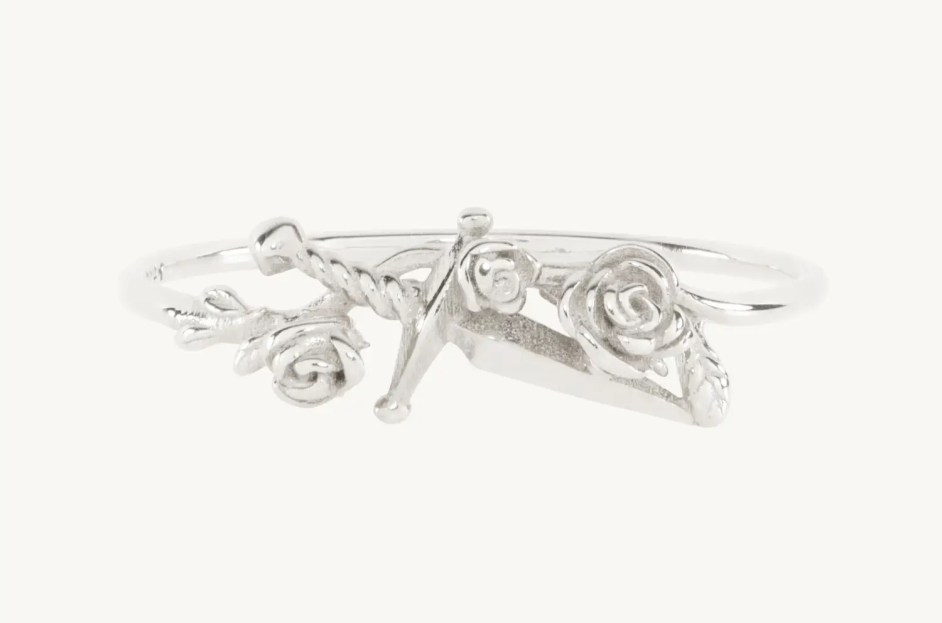
Catbird x Clairo Tender Touches Silver Dagger Ring
Up first, we have rings, a favorite accessory of ours. We’ve picked the Tender Touches Silver Dagger Ring for $98 and the Make You Blue Silver Ring for $298. Keep in mind that both of these styles also come in gold, if silver isn’t your thing. The Tender Touches Silver Dagger Ring is a thin and dainty sculptural piece that makes reference to Clairo’s 2017 song “Sis,” specifically the lyrics “Tender touches, Mend me with feathers.”
It is also meant to reference Clairo’s iconic dagger tattoo affixed to her breastbone. At the center of the ring sits a sculpted dagger with roses and vines wound around it. The band it is placed on is super thin. We can see this ring making a great layering piece because it is so thin.
The Make You Blue Silver Ring is a more statement-making piece with a chunkier silhouette. This ring takes inspo from Clairo’s 2024 song “Glory of the Snow,” specifically from the lyrics “When I cry, I wanna give you a ring, I can brеathe with you right there, hold onto me. The ring is made of 100% recycled sterling silver and features a cabochon topaz, with a swan motif swimming in a lake of tears.
Two recycled brilliant cut diamonds sit on either side of the swan motif. The band is just as thin as our last pick; however, the topaz edition gives the ring weight. When purchasing these rings on Catbird’s website, you have the option to pick out your exact ring size, giving you the perfect fit every time.
Catbird x Clairo Charmed By You Three Charm Silver Necklace
Next up, we’ve got the Charmed By You Three Charm Silver Necklace for $148. As the name suggests, the necklace features three charms all attached to a sterling silver chain. This design is also inspired by Clairo’s ‘Glory of the Snow,’ specifically the lyrics, “I pull on the string that binds me, to memories of the way I loved you.” The charms depict a dagger, a night moth, and a sparkling topaz tear.
Finally, we have our favorite additions to this collection: the charms. We’ve picked the A Flower for You Silver Charm for $48 and the Kismet Silver Charm for $98. Both charms come in sterling silver or 14K gold and can be worn two ways, on a chain or choker.
The A Flower for You Silver Charm features a bell-shaped floral motif with a pearl on the inside. This piece is inspired by Clairo’s 2021 track ‘Little Changes,’ specifically the lyrics, “A flower for you and the dogs are near.” As previously mentioned, you’ll able to fasten this charm to a choker or chain at checkout with the total price varying on size and materials chosen.
The Kismet Silver Charm pays homage to Clairo’s 2024 song “Second Nature,” specifically in reference to the lyrics “And once you get in my ear, I see kismet sinking in, It’s second nature.” The charm is made of a shimmering mother of pearl cabochon, with ‘Kismet’ scrawled on the front. The charm can be worn on either side, giving wearers endless styling possibilities.